
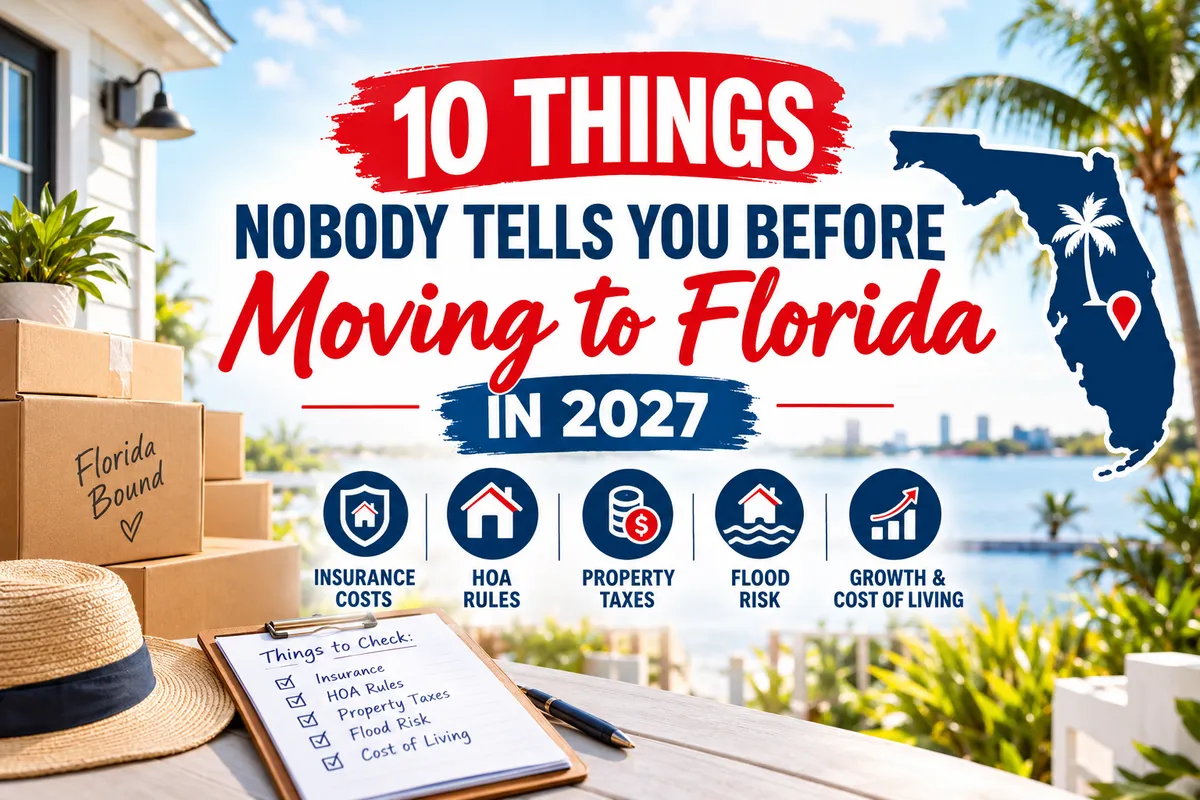
10 Things to Know Before Moving to Florida in 2027
You've read the blog posts about sharks, snakes, and hurricane season. None of that is why my clients actually end up regretting their move to Florida. I'm a realtor working in Gainesville and Ocala, and I sit across the table from buyers every week who wish someone had told them these things sooner. So here are the 10 real reasons, the ones you won't find on a typical listicle. One of them involves a $150 fee just to put chairs on a porch.
🎥 If you'd rather watch or listen to this content, check out the video!
Your Insurance Bill Depends Entirely on Your Zip Code, Not the State Average
Statewide, insurance rates are actually trending down for the first time in over a decade. Citizens Insurance cut rates about 9% across the state this year. That's real, and it's good news. But "statewide average" is a number that doesn't actually live anywhere.
Inland counties like Marion and Alachua, home to Ocala and Gainesville, can run under $2,000 a year. A coastal county like Boca Raton can run over $14,000 a year. Same state, same year, completely different bill.
Before you make any assumptions, ask an insurance agent about your specific zip code, not the state as a whole. That's the only number that matters for your budget.
HOA Rules and Community Fine Print Can Cost You More Than the Mortgage
One client, we'll call him Steve, bought a house in Ocala without reading the HOA rules closely. It wasn't the monthly fee that got him. It was the architectural review board.
He wanted to put two chairs on his front porch. That required a submission and a $150 approval fee. He changed his mind and wanted a rocker swing with two end tables instead. That was a new plan, a new submission, and another $150. Steve told me it felt ridiculous to pay for permission to arrange his own patio furniture. He ended up moving to a different community without the heavy-handed review process.
This isn't limited to small stuff, either. Some well-known 55-and-over communities come with their own fine print, like bond structures, resale restrictions, or rising fees, that buyers fall in love with the pool and clubhouse without ever asking about. Read the HOA rules and any bond or fee structure before you fall for a community, not after you've moved in.
Your Property Tax Bill Will Reset the Year After You Buy
Florida caps how much a property's tax bill can increase each year, but only for the current owner's homesteaded property. That cap does not transfer to you when you buy the home.
The year after your purchase, your property tax resets to the purchase price of the home, not the amount you financed. That means the surprise shows up on next year's tax bill, not the one you budgeted for based on the listing.
It's worth asking your agent to walk through what your tax bill is likely to look like in year two, before you're caught off guard.
No State Income Tax Doesn't Mean Florida Is Cheap
It's true that Florida has no state income tax. But in cities like Tampa, Orlando, Miami, and even Gainesville, wages haven't kept pace with the cost of living.
Rent, insurance, and groceries don't care what your state income tax rate is. The lack of an income tax is one line item. It's not the whole financial picture.
Before you move based on that one detail, run your full numbers, not just the headline.
Flood Risk, Sinkholes, and How Fast a Town Is Growing Can Change the Picture
Flood maps get updated, and flood risk can still show up even for homes in a preferred flood zone. Buyers who skip this step sometimes find out the hard way after closing. A thorough look before writing an offer includes more than the flood map. It means pulling school data, crime data, and true flood history for that specific lot.
Growth is another factor that's easy to underestimate. Some Florida towns are adding rooftops faster than the roads and infrastructure can handle. Longtime residents feel it, and many say it feels like watching the place they grew up in disappear. That's not an exaggeration. It's a real concern worth asking about.
Before committing to a town, ask how fast it's growing right now, not how fast it was growing five years ago.
The Season You Visit In Can Trick You, and Condo Costs Are Changing Fast
If you visited Florida in January and made your decision based on that trip, it's worth knowing that January is basically Florida's best sales pitch. June through September is the part nobody puts in the brochure. If possible, spend a week here in July before deciding.
Condo buyers should also pay close attention to what's happening statewide right now. After the 2021 Champlain Towers South collapse in Surfside, where 98 people died, investigators found the building's reserves had been underfunded for years. Florida responded with a new law requiring structural inspections and full reserve studies for condo buildings three stories or taller. As of this past January, boards can no longer vote to waive or underfund those reserves.
That means associations that kept dues artificially low for years are now catching up all at once. Reports this year have documented special assessments ranging from $10,000 to over $100,000 per unit, and Miami-Dade County opened a relief loan program for owners who couldn't cover the cost. If a condo is on your list, ask for the reserve study and milestone inspection report before writing an offer. The monthly fee you see today isn't the whole story.
Why This Still Matters
None of this means Florida isn't a great place to live. Insurance rates are trending in the right direction, and plenty of buyers land in a home and a community that fits them perfectly. The point isn't to talk anyone out of moving here.
The point is that checking insurance quotes, HOA documents, flood history, tax estimates, and reserve studies isn't a weekend project. It's an actual job, and doing it from out of state without someone local double-checking your work is where most of the regret comes from.
Which of These Would Be a Dealbreaker for You?
After reading through all of this, which of these ten things would you have a hard time living with, and which ones don't really bother you? That answer probably tells you more about whether Ocala or Gainesville is the right fit than any statistic ever will.
If this area still sounds like your place after all of this, I'd love to help you find the right house, not just any house. One that actually fits your budget, your lifestyle, and where you're headed. My team knows this market inside and out. We know which neighborhoods make sense, which developments are worth it, and which houses look great online but don't hold up in person.
You can read through the full buyer's guide here to understand exactly what the process looks like before you commit to anything. And if you want to know what your current home is worth before you make a move, you can get a free home valuation here. When you're ready to have a real conversation about your specific situation, book a free call here.
No pressure. No sales pitch. Just honest local expertise, and a real plan built around what your life actually looks like.