
What $350K Buys in Tampa vs. Gainesville vs. Ocala
Here's something most buyers never think to test: take the exact same budget and run it through three different Florida cities. The results aren't even close. I did this comparison because so many buyers come to me with a number in mind, but no idea how far that number actually stretches depending on where they land. What surprised me most wasn't the home sizes — it was how much the monthly cost of ownership can shift between these markets, even when the purchase price looks similar on paper.
🎥 If you'd rather watch or listen to this content, check out the video!
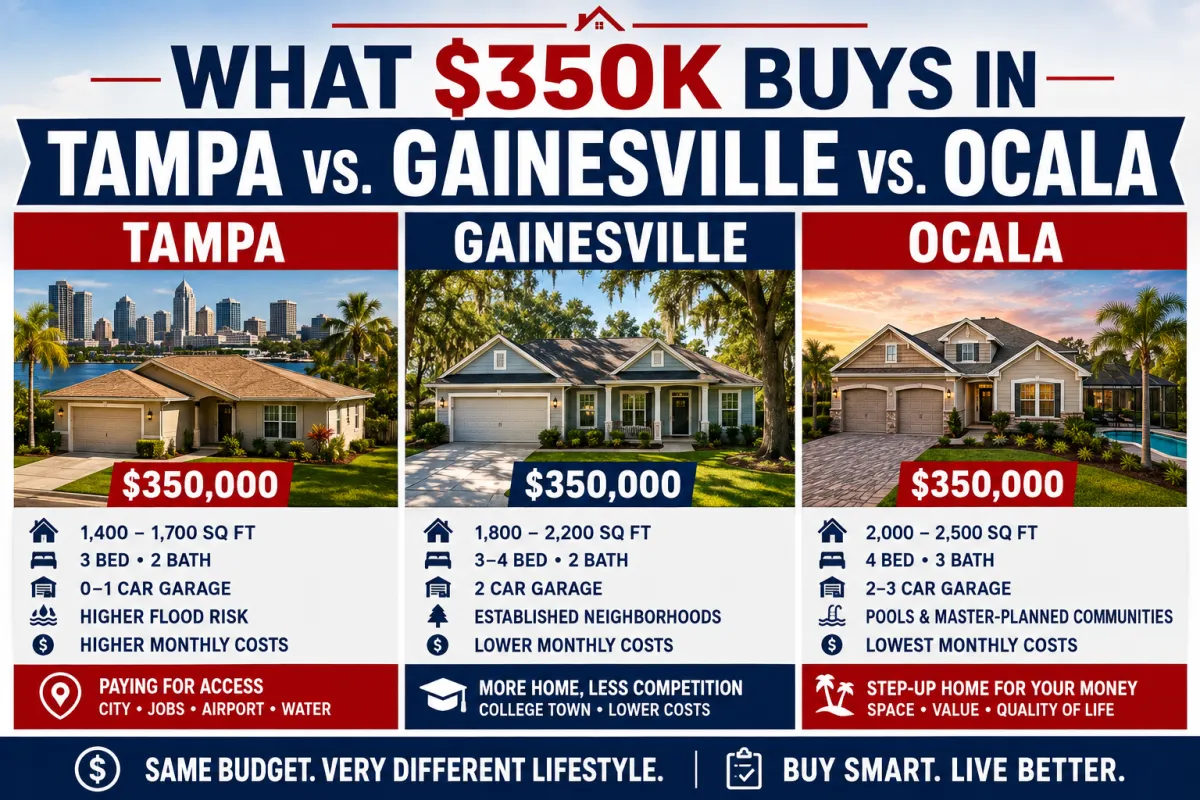
TAMPA: Your $350K Is Working Below the Median
Tampa is the most searched Florida relocation market out there, and it's also where buyer expectations and reality tend to collide. As of May 2026, the median home price for a single-family home in Tampa sits around $465,000. That puts a $350,000 budget well below the median for the city proper.
So what does that actually get you? Based on current listings, you're looking at a home between 1,400 and 1,700 square feet, most likely a three-bedroom, two-bath. A garage isn't guaranteed — you might find a one-car garage if you're lucky. Most homes in this range were built between the 1980s and early 2000s.
Flood zones are also part of the Tampa conversation. You're more likely to be near or inside a flood zone in Tampa than you are in Gainesville or Ocala. Before you fall in love with a house, check the FEMA flood maps for that address, and if it is in a flood zone, get a quote from a local insurance agent so you know that cost before you make an offer.
If you're flexible on location, areas like Ruskin or Sun City Center have median home prices between $300,000 and $320,000 — more house, but likely more commute time to work or the things you enjoy. That's not a downgrade, just a different version of the market. At $350,000 in Tampa, you're mainly paying for access — to your job, the airport, and the water.
GAINESVILLE: More Home, Less Competition
As of May 2026, the median home price in Gainesville is around $378,000, which puts a $350,000 budget just under the median — without the same level of competition you'd face in Tampa.
That budget buys a home between 1,800 and 2,200 square feet, typically a three- or four-bedroom, two-bath, most likely with a two-car garage. These are often well-maintained homes in established neighborhoods, frequently with a yard, and sometimes a community pool with a low HOA.
Gainesville is anchored by the University of Florida, which brings a stable, diverse local economy and a major academic medical center in UF Health Shands. It also means the city runs year-round rather than seasonally — though you'll notice the traffic difference when college students leave for the summer. If you're open to living 20–30 minutes outside the city, towns like Newberry or Alachua have a median home price around $320,000.
The honest trade-off: Gainesville isn't Tampa. There's no waterfront or major international airport, and it doesn't have that big-city energy. But if your daily life revolves around your neighborhood, your medical care, your family, and your cost of living, Gainesville delivers more per dollar than almost any other Florida city at this price point.
OCALA: Where $350K Becomes a Step-Up Home
Ocala's median home price for a single-family home in May 2026 was $299,000. That means $350,000 in Ocala isn't buying a median home — it's buying a step-up home.
At that budget, you'll find a large number of homes between 2,000 and 2,500 square feet, often four-bedroom, three-bath, with a two- or three-car garage. A resale home might come with a pool. In a new-build community, you're more likely to get a community pool along with a builder's warranty and modern finishes. Some communities in this price range include master-planned options with resort-style amenities like pools, fitness centers, and sports clubs built into the HOA — though inventory moves quickly, so it's worth verifying availability with your agent before setting up a tour.
The honest trade-off here is the job market. Ocala isn't a major metro, so if you need access to a large corporate employment base, you're either commuting or working remotely. For a major airport, you'd be driving to Gainesville for regional service, or Tampa and Orlando for international flights.
The Real Monthly Cost Nobody Compares
The purchase price is what you see. The monthly cost of ownership is what you actually live with — and it changes the math more than people expect.
In Tampa, Hillsborough County property taxes rank 39 out of 67 counties, and insurance in coastal or near-coastal areas runs significantly higher than inland. Most Tampa communities also have an HOA. Altogether, the monthly cost of owning a $350,000 home in Tampa can run $500 to $700 a month higher than the same home in Ocala.
Gainesville has the second-highest property taxes in the state (St. Lucie County ranks number one), but insurance tends to be lower than Tampa since it's inland. There are several HOA communities, but also plenty of established neighborhoods with no HOA at all — which usually keeps the overall monthly cost of ownership below Tampa's.
Ocala is also inland, so insurance costs tend to stay in line with Gainesville and well below Tampa. Marion County property taxes rank 38, putting them roughly in line with Tampa's rate. The takeaway: run both numbers — purchase price and true monthly cost — before you decide on a market.
Which Market Actually Fits Your Life
None of these three answers is wrong. They're just three different answers for three different lives.
If you're job-transferring and need a major employment base, an international airport, and big-city infrastructure, Tampa is worth the premium — just go in with clear eyes about what $350,000 actually buys there. If you want college-town quality of life, a major academic medical center, and a lower overall cost of ownership, Gainesville delivers more per dollar than most buyers expect. And if you're retiring, working remotely, or choosing lifestyle and value over metro access, Ocala comes out as the clearest winner at this budget.
Why This Comparison Still Matters
It's easy to fixate on the sticker price and forget everything that comes after closing. But the same $350,000 puts you in three completely different financial positions depending on the city — different square footage, different flood risk, different taxes, and different monthly payments. Knowing which trade-offs you're actually willing to live with is worth more than any single statistic.
Here's My Question for You
Out of everything covered here — home size, flood risk, job market access, and monthly ownership costs — which of these matters most to you, and which ones could you live without? That answer tells you more about whether Tampa, Gainesville, or Ocala is the right fit than the median price ever will.
If one of these markets sounds like your kind of place after reading this, I'd love to help you figure out the right fit — not just any house, but the one that matches your budget, your lifestyle, and where you're headed. My team knows these markets inside and out. We know which neighborhoods make sense, which developments are worth it, and which homes look great online but don't hold up in person.
You can read through the full buyer's guide here to understand exactly what the process looks like before you commit to anything. And if you want to know what your current home is worth before you make a move, you can get a free home valuation here. When you're ready to have a real conversation about your specific situation, book a free call here.
No pressure. No sales pitch. Just honest local expertise — and a real plan built around what your life actually looks like.