
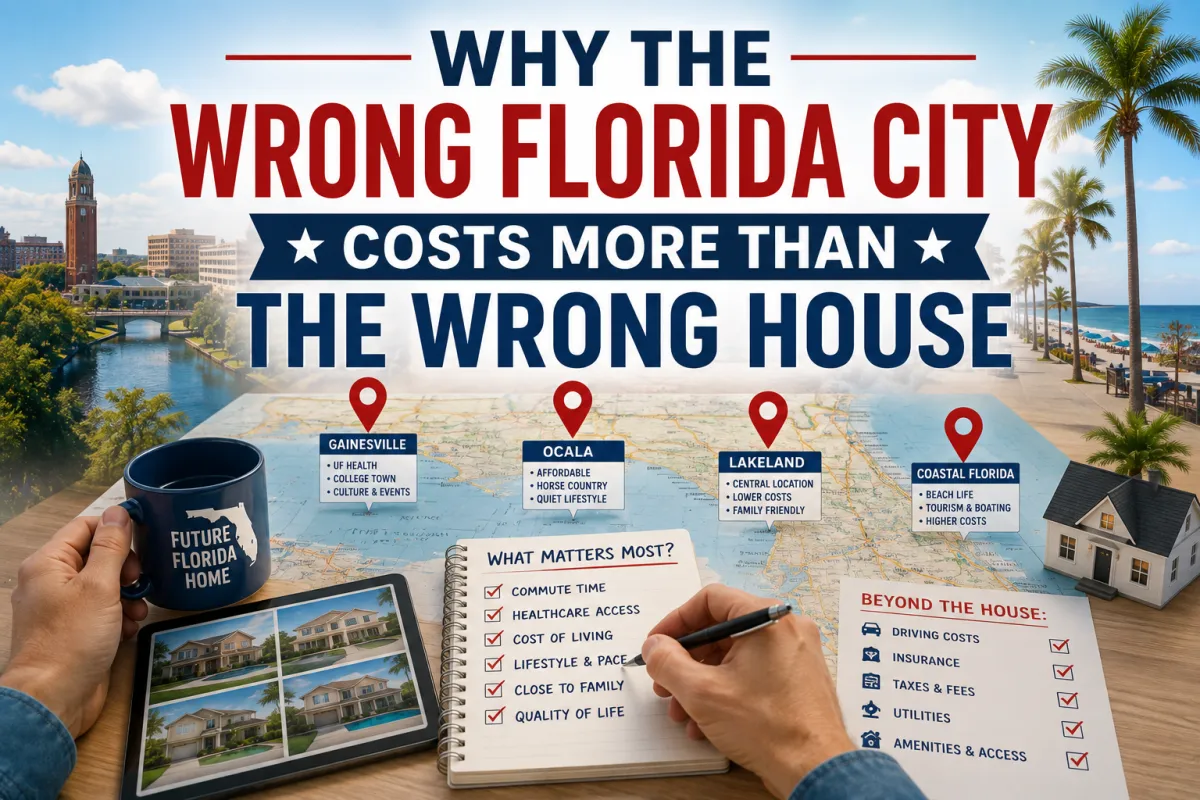
Why the Wrong Florida City Costs More Than the Wrong House
If you're moving to Florida, here's something that might surprise you: the wrong city will cost you more than the wrong house ever will. I know that sounds dramatic, but I see it happen over and over again. Buyers spend all their energy worrying about kitchens, floors, and backyards, and almost none of it on the one decision that actually shapes their day-to-day life. I help buyers moving to Florida choose the right city and avoid expensive mistakes, and this is the pattern I run into constantly. Stick with me, because the fix is simpler than you'd think.
🎥 If you'd rather watch or listen to this content, check out the video!
You're Choosing a Lifestyle First, a House Second
Most buyers think they're making a housing decision. They're actually making a lifestyle decision first. A house sits inside a city, inside a pace of life, inside a driving pattern, inside a cost structure. A home in Gainesville is a very different life than a home in Ocala, even with the same budget.
This is where buyers get fooled. They think they're comparing real estate, but they're actually comparing traffic, healthcare access, airport access, and neighborhood feel. Those things matter a lot more than white or brown kitchen cabinets.
The fixable stuff, like an outdated layout or a paint color you hate, costs money but it's temporary. The wrong city creates daily friction you can't renovate your way out of.
Commute and Driving Costs Add Up Fast
A lower home price can look like a great deal on paper. But if it pushes you further from work, the hospital, the airport, or your family, that "savings" just gets spread out across every single day of your life.
One buyer's example says it best: an extra 45 minutes each way, five days a week, twice a day, just to save a little upfront on the house. Was it really worth it? That extra drive means more gas, more oil changes, more tires, and more wear and tear on your daily routine.
Lifestyle Mismatch Is a Real Cost, Not Just a Feeling
Some buyers want more energy, more convenience, more access. Others want more land, more quiet, less chaos. Neither is wrong, but if you land in the wrong pace of life for you, you'll feel it fast.
A city can be objectively nice and still be the wrong fit. That's not a knock on the city. It's just a mismatch, and mismatches are expensive in ways that don't show up on a closing statement.
A Cheaper House Isn't Always a Cheaper Life
Some buyers pick a city because the home prices look more comfortable. But once you factor in insurance, property taxes, commute costs, HOA fees, and utility patterns, that "cheaper" city may not actually save you anything.
The math only works if you look at the full picture, not just the price tag on the house.
Access to What Matters Should Be Chosen on Purpose
If healthcare access matters to you, that needs to be part of the decision from the start. Same goes for airport access, school options, shopping, restaurants, outdoor lifestyle, or being close to family.
These things should be chosen on purpose, not discovered afterward like an unpleasant surprise. Buyers who skip this step often end up boxed in sooner than they expected, and that's when the "we'll work it out" phase turns into the "why did we do this" phase.
The Online Trap: Everything Looks the Same on Paper
Buyers often send over homes from completely different Florida markets, and on paper, they all look reasonable. Nice photos, good sizes, decent prices, maybe even a pool. Florida is good at tempting buyers that way.
But once you start asking better questions, the differences show up fast. One house has more square footage but is much farther from the hospital. Another looks like a better deal, but adds real time to your daily commute. Another checks every box except one: it's two hours from the water, which was the whole point of the move.
The internet trains buyers to search by price, bedrooms, bathrooms, and garage space. Those things matter, but they're not the starting point. The house is the property. The city is your lifestyle.
Why This Still Matters
None of this means the house doesn't matter. It absolutely does. But the order matters more than people realize. Buyers who choose the city first, then the area, then the house tend to end up with a life that actually fits, not just a listing that looked good online.
The good news: once the city is right, the home search gets so much easier. You're no longer comparing apples to oranges across five different markets. You're just comparing houses inside a city you already know works for you.
Here's My Question for You
After everything in this article, which of these five things — commute, lifestyle, budget, access, or long-term flexibility — is a dealbreaker for you? And which ones can you live with? That answer tells you more about whether a Florida move will actually work than any listing photo ever will.
If Gainesville, Ocala, or the surrounding area sounds like the right fit after thinking this through, I'd love to help you find the right house — not just any house. The right house that fits your budget, your lifestyle, and where you're headed. My team knows this market inside and out. We know which neighborhoods make sense, which developments are worth it, and which houses look great online and don't hold up in person.
You can read through the full buyer's guide here to understand exactly what the process looks like before you commit to anything. And if you want to know what your current home is worth before you make a move, you can get a free home valuation here. When you're ready to have a real conversation about your specific situation, book a free call here.
No pressure. No sales pitch. Just honest local expertise — and a real plan built around what your life actually looks like.